I’ve flown cakes through TSA dozens of times, and it’s simpler than you’d expect. I keep my cake under 15 inches tall so it slides through scanners; domed tops get rejected fast. I pack it in a sturdy box with four inches of padding on every side, keeping frosting separate in containers under 3.4 ounces. Frozen layers travel best because they slowly defrost mid-flight without collapsing. I double-seal everything with tape for easy re-inspection, and I always check my airline’s personal item limits first, typically around 18″×14″×4″ fits under most seats. If TSA asks questions, I explain that I have solid cake in my bag with compliant frosting attached. Successfully transporting your dessert intact requires attention to temperature control, container dimensions, and TSA liquid restrictions.
Yes, You Can Bring Cake Through TSA Security
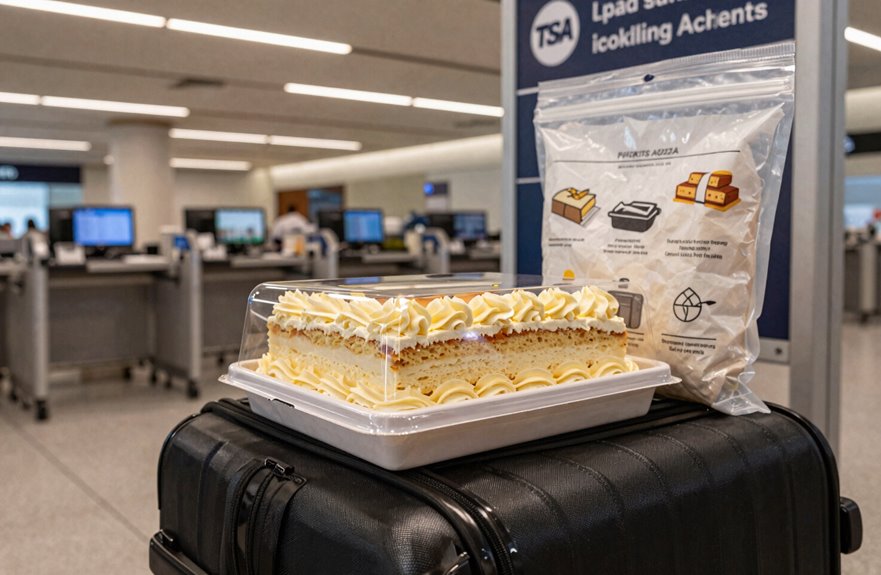
Why stress about leaving your celebration dessert behind. You can absolutely bring your cake through TSA security.
Here’s what you need to know about packing cakes for flights: your dessert needs to slide through that scanner without causing headaches. Keep it around 12 to 15 inches tall. Anything bigger triggers oversized handling. Domed cakes that tower over the limit get rejected.
Pack your cake 12 to 15 inches tall—anything bigger gets flagged for oversized handling or rejected at security.
Watch your frosting situation carefully. TSA treats thick frostings and creamy fillings like liquids, so containers over 3.4 ounces belong in checked baggage, not your carry-on. Buttercream and similar spreads exceeding this threshold will be confiscated from carry-on luggage.
When you’re packing, remember your cake box counts as a separate carry-on item. Check your airline’s specific guidelines before heading to the airport.

1.Well to Transport :Great for Taking and Toting all Your Baking Needs! The Clips on the Side Make it Easy for Containing Baked Goods and Keeping Them Airtight.Worked really well for traveling. It is sturdy enough,Easy to Carry.

Sturdy Material: Made of high-quality polyester fabric, and this work backpack for men & women is water-resistant, tear-resistant, wear-resistant. Smooth and sturdy double metal zippers, sturdy top handle, and reinforced stitching at each stress point make the laptop backpack more sturdy for long-term use

4-in-1 Design:Our cake carrier with lid and handle consists of four parts: a cupcake holder, an egg holder, a reversible base, and a transparent cake dome cover. It combines the functions of a cupcake holder, a deviled egg platter, a cake stand, and a snack transport container. This multi-functional container can meet various needs in your daily life and travel
Choose a Box That Fits the Airport Scanner

I learned the hard way that scanner size limits are no joke after watching a fellow passenger’s oversize box get rejected at the checkpoint. You’ll want a sturdy cardboard box with solid, flat sides, ideally no more than 12 to 15 inches tall, to slide smoothly through the TSA’s X-ray machine without triggering a manual inspection. Pick one that’s at least 4 inches larger than your cake on every side; that extra buffer protects your frosting from the bumps of travel and gives agents room to peek inside without destroying your handiwork.
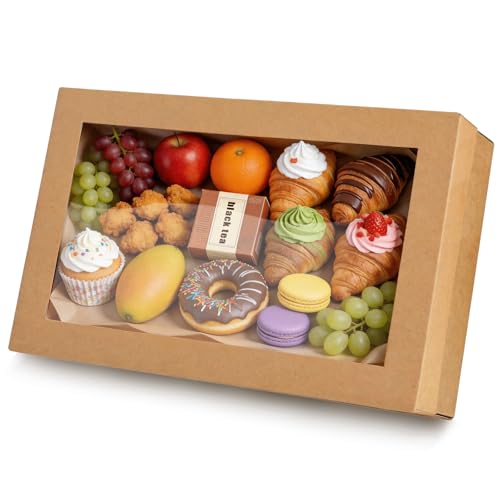
【Package Included】You will receive 10 pack cookie boxes with window (Each box contains a piece of greaseproof paper). The boxes are measuring about 17.7x12.2x3.15 Inch. Enough space and quantity to hold quite a few desserts, meeting your daily needs.
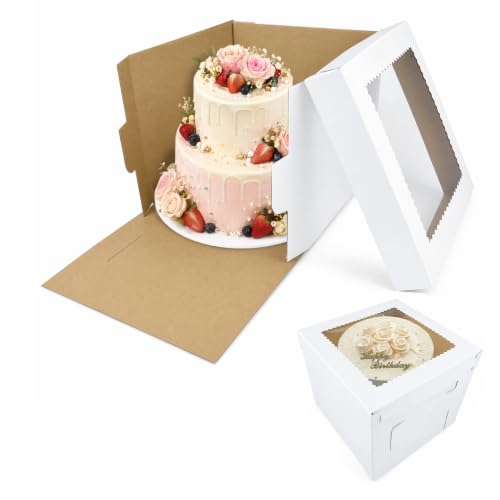
STURDY CORRUGATED MATERIAL: Made of premium corrugated material for enhanced sturdiness and durability, these large cake boxes offer superior load-bearing performance to protect cupcakes and baked goods from bending or collapsing during transport

Premium Quality Materials: Heavy duty premium kraft corrugated cardboard boxes. Our cake boxes are thick and sturdy. The environmental-friendly materials are recyclable and degradable.You can trust to hold and ensure your cake and goodies’ protection while on display and on transport.
Scanner Size Limits
At the security checkpoint, your cake box faces its first real test: sliding through the TSA scanner without a hitch. Scanner limits cap box size around 12–15 inches tall, so measuring twice before packing is essential. Domed tops cause problems; they jam the conveyor, and suddenly you’re holding up the line.
For carry-on cake packing, flat, low-profile lids work best. Structured cardboard with solid sides keeps everything intact while squeezing through narrow openings. If your creation grows too ambitious, split it into stackable layers in separate, compliant containers. You’re not compromising your masterpiece; you’re working within machine dimensions. TSA won’t bend the rules, but you can work within them. Proper sizing prevents frosting disasters and keeps flights running smoothly.
Sturdy Box Selection
How do you keep a cake intact from kitchen to cabin. I’ve learned it starts with choosing the right container.
I always grab a sturdy box with solid cardboard sides, none of those flimsy bakery boxes that collapse if someone breathes on them. Your cake deserves better than a crushed frosting disaster.
I need my box to fit through security scanners smoothly, so I stick around 12-15 inches tall. Skip domed lids; they snag and cause headaches at checkpoints.
Inside, I add parchment lining to keep everything from sliding around during turbulence or rough baggage handling. A non-slip layer works wonders too.
Finally, I seal it tight with packing tape and slap on a clear “CAKE” label. Screeners appreciate the heads-up, and you’ll avoid damaged cakes at your destination.
Height Restrictions Matter
Since I’ve already locked down a sturdy box, I’ve got to make sure it actually fits through the scanner. Otherwise, I’m just carrying a very pretty paperweight.
The TSA scanner typically accommodates items 12–15 inches tall. I always measure my box height before leaving home, including any domed lid or decorative frosting that adds bulk. Cake packing demands flat, sturdy structures with no fancy tops that poke too high. Exceeding scanner dimensions triggers extra screening or forces repackaging at security, which means disassembling dessert in front of impatient travelers.
For towering creations, I slice beforehand. Smaller portions slide through cleanly. Staying within size constraints keeps my journey smooth and my cake intact.
Stabilize Your Cake for the Journey
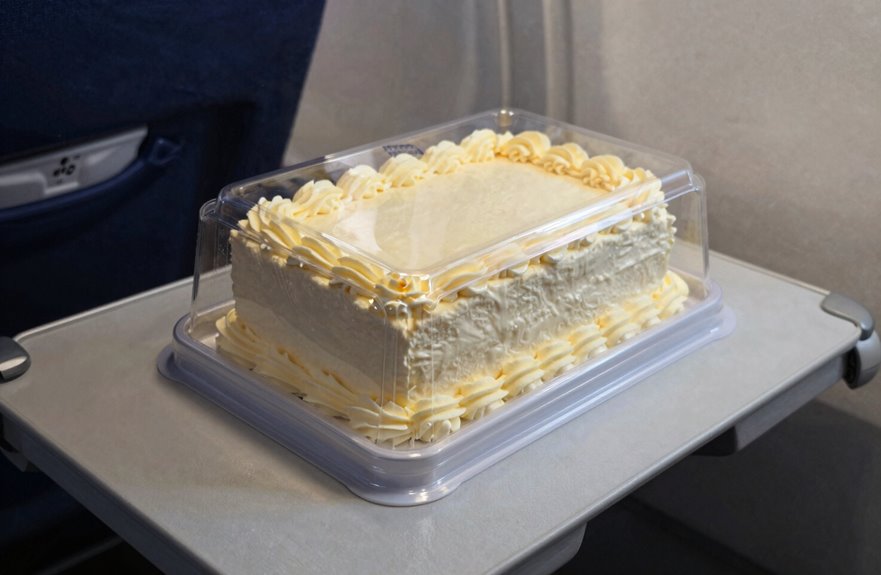
A cake’s survival depends on three requirements: a box with four inches of space on every side, contents secured so they cannot shift, and temperature control that keeps buttercream from melting. Skip any one of these, and you’ll present TSA with a crumbly disaster instead of dessert. Here’s how to execute each step.


【 Complete Cake Display Set 】 This 5-piece combo pack includes five 10" black trays, five clear high dome lids, and five 10" corrugated white cake boards, providing everything you need to elegantly showcase your delicious cakes.

Choose a Sturdy Box
Your cake’s survival depends entirely on the box you pick. I learned this after watching a beautiful buttercream collapse because I trusted a flimsy bakery container. Now I only use sturdy, structured boxes with solid sides that won’t buckle when navigating crowded terminals.
Size matters enormously for carry-on compliance. Measure your box against airline dimensions before you bake, accounting for domed tops that push height limits. Security scanners require flat, manageable profiles that won’t draw additional inspection.
Inside, add strategic padding: parchment paper or non-slip shelf liner keeps everything anchored. Finally, seal every edge with duct tape. If TSA wants a peek, you can reopen and reseal without the box falling apart. This prevents structural failure during transport.
Secure Internal Contents
A sturdy box means nothing if your cake slides around inside like a hockey puck on ice. Internal security matters just as much as the container itself.
Freeze your cake layers solid before packing. This prevents shifting. A rigid cake board provides structural support, and choose a box four inches larger on all sides. That buffer zone protects against movement during transport.
Double-wrap everything in plastic, creating an airtight seal. Then slip the whole package into a large plastic bag. For maximum security, keep frosting separate in a Ziploc bag until arrival. This prevents smushed roses and leaks.
These packing techniques transform your cake from vulnerable cargo into travel-ready treasure. Your first slice will look picture-perfect when you arrive at your destination.
Control Temperature Properly
How exactly does a cake survive hours in an unpredictable climate without turning into a sad, saggy mess? Temperature control makes or breaks your cake preservation.
I freeze my layers solid first (about 2-3 hours does the trick), then pack them in a coolbox with frozen gel packs. This travel packing strategy keeps everything stable while TSA sorts through security. During the flight, the cake slowly defrosts, which actually reduces stress on the structure. No sad, weeping layers result from this method.
I double-wrap everything in cling film, then seal it in a sturdy box. Perishable fillings stay separate until arrival. Once you land, the cake goes into refrigeration immediately. This approach prevents deterioration during transport and storage.
Pack TSA-Compliant Frosting Separately

Why risk a frosting fiasco at security when a little prep keeps things smooth. Frosting containers must follow the same 3.4-ounce carry-on limit as your shampoo. I transfer my buttercream into small, clear jars and double-check each one. No one wants to surrender their hard work at the checkpoint.
For leak-proof packaging, I seal those containers tight, then slip them into a zip-top bag inside a sturdy box. It’s overkill until it isn’t. When I need more than a few ounces, I split the batch or check a bag. This approach prevents confiscation at TSA.
I keep frosting away from my cake layers and tuck ingredient notes nearby. Officers appreciate transparency, and you’ll have a clear record of your contents.

Food-Grade Materials: Our cake containers with lids is safe for hot or cold foods and gives you a solid, eco-friendly alternative to cheap plastics or expensive metal tray and cover sets.

3 CAKE DISPLAY COMBO PACK – this set includes 3 black 10" trays, 3 clear high dome lids, and 3 10" corrugated white cake boards. Perfect for putting your delicious cakes on display! The lid is tall enough to accommodate cakes with 2-3 layers that are up to 10" in diameter. Since the lid is clear, your guests will have an excellent view of the entire product!

Food-Grade Materials: Our cake containers with lids is safe for hot or cold foods and gives you a solid, eco-friendly alternative to cheap plastics or expensive metal tray and cover sets.
Seal Your Box for Easy Inspection and Resealing
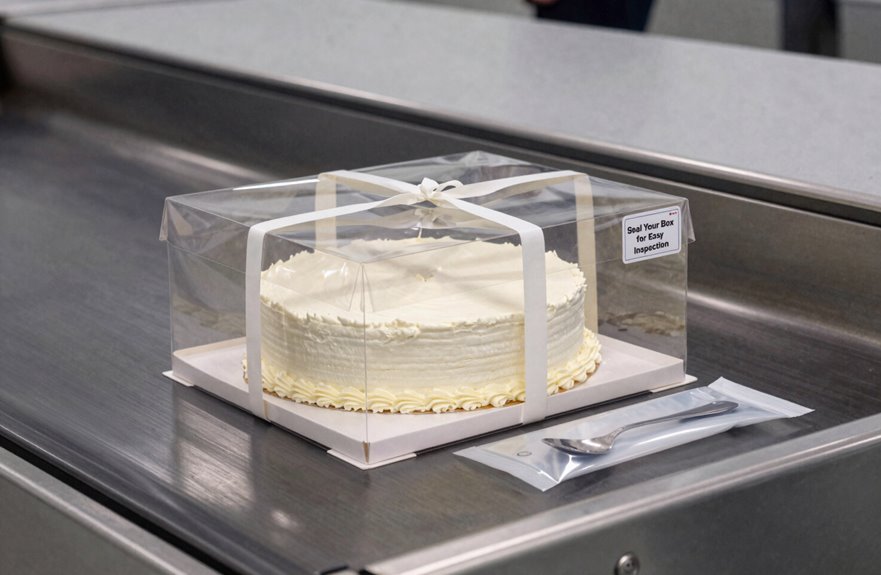
Once my frosting’s squared away, I turn my attention to the box itself. Even the most secure cake won’t survive a flimsy container. I grab a sturdy, structured cardboard box with solid sides; no flimsy bakery boxes allowed here. The box must withstand baggage handlers who treat fragile stickers as suggestions.
I reinforce every seam with duct tape. It’s not pretty, but it works. I stash extra tape in my carry-on for resealing after TSA inspection. Agents will peek inside, and I want that box closed tight again fast.
My quick checklist:
- Rigid cardboard that holds its shape under pressure, even with a domed top
- Duct-taped edges forming a protective armor around vulnerable corners
- Extra tape strips pre-cut and ready for rapid resealing post-inspection
Your cake deserves this level of care. Your ability to transport it successfully depends on these steps.

Our portable refillable cosmetic containers are well made, easy to fill and use, press smooth, liquid flow smooth, no leaks, vacuum design keeps the contents clean and hygienic, there is no waste.

Rich Accessories: Comes with 2 funnel, 4 dropper, and 2 injection tube, which brings great convenience to the filling (Note: Old inventory does not include injection tube, new and old inventory is randomly shipped)

Leak Proof: These 1oz portable water bottle meets our daily needs. It features a three-layer leak-proof design, equipped with a stable flip cover and an internal stopper, which can effectively prevent liquid from leaking.
Bring Your Cake as Your Personal Item
Where exactly does your cake sit when you’re already maxed out on carry-on space? Most airlines let you bring your cake box as a personal item, the precious under-seat spot usually reserved for a purse or laptop bag. It’s separate from your carry-on, which maximizes your packing efficiency.
Your cake box needs to meet specific requirements. Solid sides keep your dessert from getting squashed, and dimensions must fit standard personal item limits. At TSA security, be prepared with extra tape in your pocket for resealing after inspection. Domed tops should be skipped. Flat lids slide through scanners without complications.
If you’re packing frosting separately, keep it under 3.4 ounces. Otherwise, buttercream stays put. This strategy successfully gets your cake through security and onto your flight.

4-in-1 Design:Our cake carrier with lid and handle consists of four parts: a cupcake holder, an egg holder, a reversible base, and a transparent cake dome cover. It combines the functions of a cupcake holder, a deviled egg platter, a cake stand, and a snack transport container. This multi-functional container can meet various needs in your daily life and travel

【Value Package】- The package contains 20 pieces 11"L x 4.3"W x 4"H" Inches Clear transparent pastry boxes. Include white cake cardboards. This set has enough quantity for your daily life, holidays or gifts.

Made from BPA-free material
Check Your Airline’s Size Rules Before Flying
How big can my personal item actually be? Airline size rules aren’t universal, so I always double-check before packing my cake box. Most carriers let me bring it as a personal item separate from my carry-on, but dimensions vary widely.
- A standard cake box measuring 18″×14″×4″ squeezes under most seats
- Some airlines require flat, non-domed lids for overhead bin compatibility
- International flights demand extra scrutiny for customs declarations
I measure my cake box against published limits online rather than guessing. Weight restrictions apply too. If I’m pushing boundaries, I call customer service. My cake travels without incident when I verify my personal item meets airline specifications. Airline size rules protect your dessert from gate-check surprises. Verify beforehand to avoid discovering at boarding that your item doesn’t meet size requirements.

【Package Included】You will receive 10 pack cookie boxes with window (Each box contains a piece of greaseproof paper). The boxes are measuring about 13.78x9.84x3.15 Inch, just the proper size to pack varieties of food. Enough space and quantity to hold lots of desserts, meeting your daily needs.

Cake Box with Cake Board: include 6pcs 19x14x5 inches white cake boxes and 6pcs 19 inch cake sheet cake board. Large rectangle size is suit for 1/2 sheet cakes, king cakes or other bakeries, pastries, pies and desserts. Double layer cake board gives your cake stronger support and good display.

Cake Boxes 10 Inch with Window – These cake carriers fit 8-inch cakes perfectly, and the clear top window showcases your beautiful treats while keeping them fresh. Made of food-grade paperboard, these cake containers are safe for direct contact with food and eco-friendly – a professional choice for home bakers or commercial bakeries.
Keep Your Cake Safe in Your Seat Area
Although I’d love to keep my cake on my lap the whole flight, I’ve learned the hard way that turbulence doesn’t care about my frosting. I always slide my packing creation under the seat in front of me, the most stable spot in the cabin. The overhead bin works only if I’m flying smooth skies; otherwise, my precious layers tilt and crack. My cake box must measure within personal item limits, typically 16″x13″x8″, so it fits snugly without crushing. I double-seal frosting in leak-proof containers because nobody wants buttercream on their neighbor’s shoes. I tuck a spare slice in a separate container as backup. When the seatbelt sign dings, I’m ready. My cake stays put, my seatmates stay happy, and my dessert survives the flight intact.

Value Pack: You will receive 100 clamshell take-out containers, each measuring 4.6 x 5.2 x 2.8 inches, ample quantity will meet your daily needs and perfect for picnics, bakeries, take-out, parties and gatherings.

Package includes:100 pcs cupcake Boxes.Clear Plastic Cupcake Boxes, Environmental BOPS material.

Durable Rectangular Design: Perfect for storing and serving cakes, this sturdy container keeps your treats fresh and secure
Frost and Decorate at Your Destination
Once I’ve landed and claimed my seat, the real fun begins. I grab my carry-on and pull out the small bag where I’ve stashed my frosting and decorating supplies. These packing tips pay off immediately.
- I transfer the frosting from its travel container, letting it defrost slowly if chilled so it spreads smoothly
- I use an offset spatula to create texture and smooth edges, wiping excess on a bowl as I work
- I add sprinkles and piping only after the frosting sets enough to hold them
Timing matters. I wait ten to fifteen minutes for the right consistency. Room temperature affects spreadability, so I adjust my technique accordingly. The result connects me to a community of travelers who refuse to sacrifice celebration. Together, we’ve solved the puzzle of cake at 35,000 feet and beyond.
3 CAKE DISPLAY COMBO PACK – this set includes 3 black 9" trays, 3 clear high dome lids, and 3 9" corrugated white cake boards. Perfect for putting your delicious cakes on display! The lid is tall enough to accommodate cakes with 2-3 layers that are up to 9" in diameter. Since the lid is clear, your guests will have an excellent view of the entire product!

✅Material : Made of plastic, with lid to ensure your stored foods are kept healthy, fresh & safe for your friends & family to enjoy!

Food-Grade Materials: Our cake containers with lids is safe for hot or cold foods and gives you a solid, eco-friendly alternative to cheap plastics or expensive metal tray and cover sets.
Handle Security Questions Smoothly
Why does TSA always seem to pick the one traveler juggling a fragile dessert? I’ve learned to roll with it. When officers ask about my carry-on cake, I answer clearly: solid food passes, but frosting in separate containers faces the 3.4-ounce liquid rule. I keep my box around 12–15 inches tall and present it willingly for inspection. I pack extra tape and a spare seal; officers sometimes need to reseal after checking. If I’m bringing frosting separately in checked bags, I ship anything over 3.4 ounces ahead. This approach ensures TSA compliance while protecting the cake’s integrity during transit.
| Scenario | What I Do | Why It Works |
|---|---|---|
| TSA asks about cake contents | Explain it’s solid food in carry-on | Solid foods are clearly allowed |
| Officer questions frosting | Note it’s attached, not separate | Attached frosting avoids liquid rules |
| Box needs inspection | Open smoothly, offer to assist | Shows cooperation, protects cake |
| Seal breaks during check | Apply spare tape immediately | Keeps cake secure and presentable |
| Traveling with liquid frosting | Pack in checked bag or ship ahead | Avoids 3.4-ounce carry-on limit |

Compact Travel Size: The slender dimensions of 7.8x2.2cm (3.1x0.9in) make these bottles exceptionally portable and space-saving for any journey

✅WELL-DESIGNED: These airless pump bottles are designed without straws to keep fresher for longer, increasing their shelf-life and preventing the oxidation of the cosmetics and the growth of bacteria.

Compact and Portable: These small travel containers are meticulously designed for ease of travel. Lightweight and compact, they comfortably fit in your carry-on luggage, making them perfect for all your travel adventures.