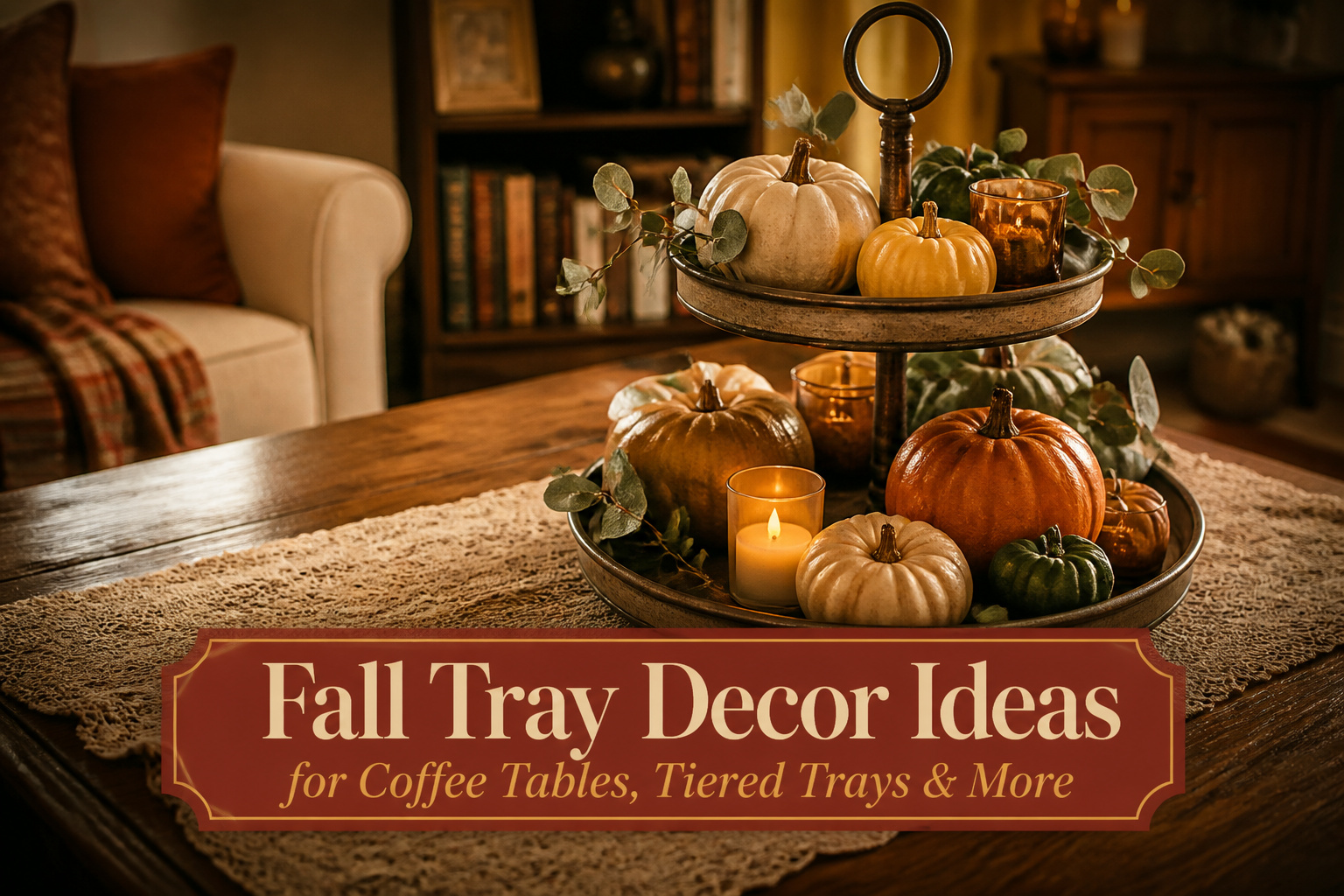
Fall tray decor works across budgets and skill levels, from a single thrifted lantern to a handmade tiered tray built from stacked cake pans.
What separates the arrangements that last through November from the ones that get cleared by mid-October is not style but maintenance: battery candles instead of open flame on wood surfaces, hairspray on cotton stems to stop shedding, and parchment under real pumpkin vases that soften in five to seven days.
1. Autumn Lantern and Pumpkin Tray Decor
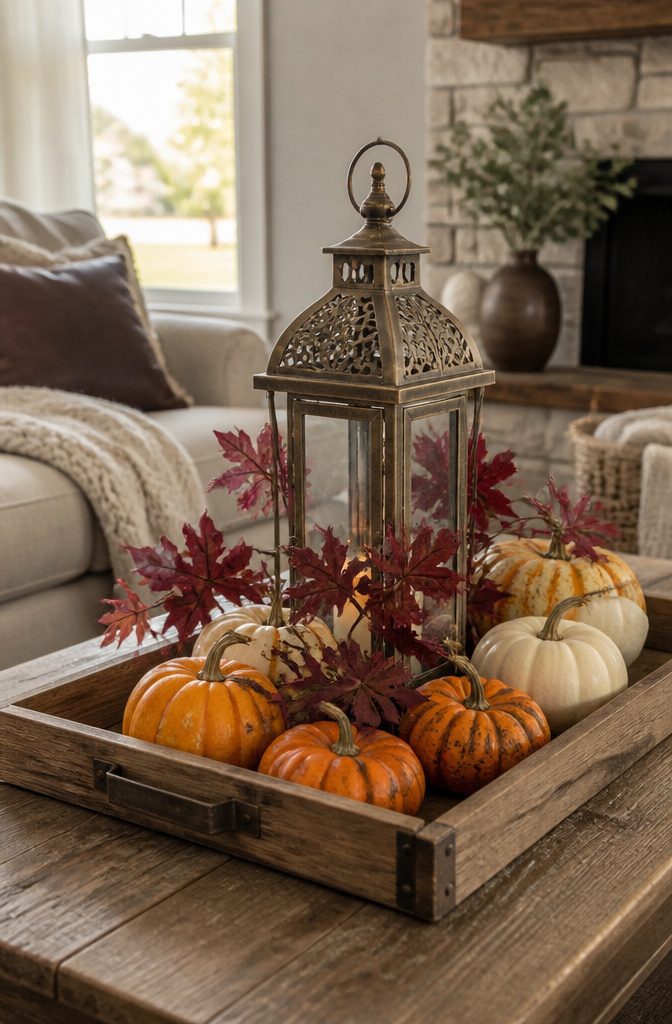
A bronze metal lantern sitting on a wood tray gives autumn decor its weight. The metal catches low afternoon light the way an actual October window does, and the hollow frame inside is meant for a candle.
Battery-operated candles fix the one problem wood and wicker trays create: open flame against dry material is not a risk worth taking for a centerpiece that sits unattended through dinner.
The battery kind flicker convincingly now, and they do not leave wax scars on the tray surface.
Small pumpkins around the lantern base fill the gaps without competing.
Burgundy maple leaf branches, the silk kind sold in six-piece sets, can lean between the pumpkins and the lantern legs so the metal does not read as too bare or too heavy.
The palette runs dark and warm, more October evening than harvest festival.
Round woven trays work here too, though the texture competes more with the lantern’s detail.
A hand-carved wood serving tray keeps the focus on the vertical piece. Either way, the lantern wants to be the tallest thing present; anything else near its height splits the arrangement into two arguments.

【Pumpkin Design & Real Wax】These pumpkin flameless candles are crafted from real wax with 3 unique pumpkin shapes in orange, green, and beige. The lifelike texture makes this LED candle set perfect for fall decor, Halloween, and Thanksgiving displays

SPOOK YOUR HOME THIS HALLOWEEN - Place the pumpkin lights into Halloween pumpkins - Two modes to choose by remote control: FLICKER (flickering effect) & STEADY (steady glow) - In FLICKER mode, emit eerie orange glow against a diabolical grin on the pumpkin to send an electrifying chill down the spine - In STEADY mode, light up the pumpkin to welcome the ghoulish guests and create a spooky Halloween - Cluster the lighted pumpkins together or scatter them around to spook your home this Halloween!

LIFELIKE FLICKERING CANDLELIGHT: The warm white glow flickers like a real candle from across the room, while the melted-edge design adds realistic detail up close; create cozy candlelight across votive holders, table centerpieces, mantels and seasonal displays
2. Natural Accents and Coffee Table Books
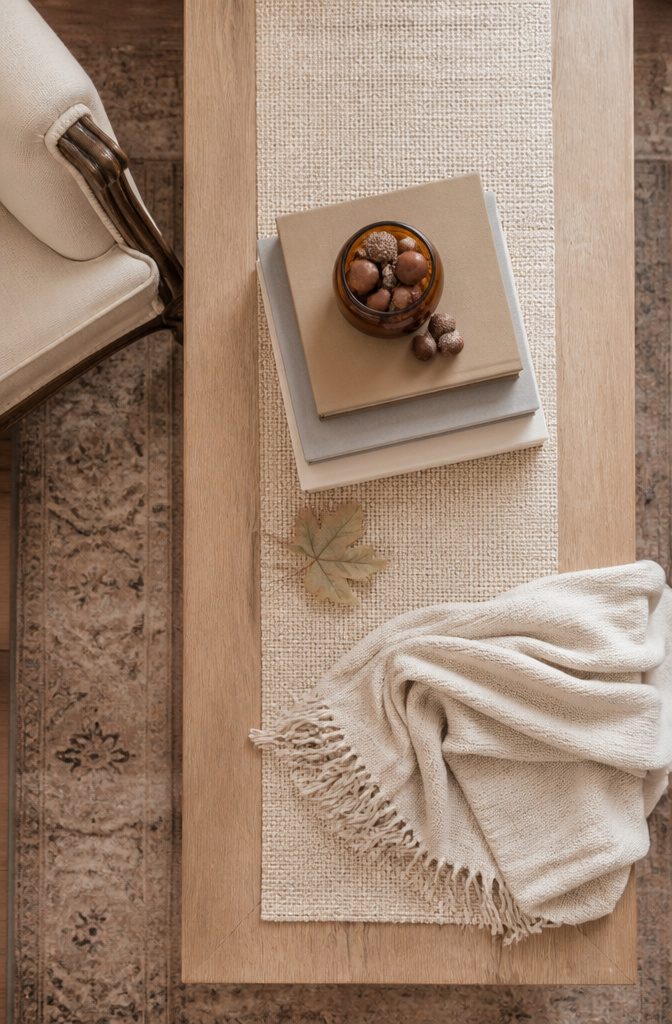
Stacked books solve the height problem most flat trays have.
Three or four hardcovers, largest on the bottom, build a stepped platform that breaks up a long coffee table without looking staged. The trick is keeping the spines quiet.
Neutral-toned hardcovers work best, because a bright red spine or loud title fights whatever acorns, pinecones, or small vase you set on top. The tray carries the seasonal message; the books are just the architecture.
I learned this the hard way after trying a vintage orange cookbook that competed with everything around it.
Swapping it for a plain linen-bound journal let a cluster of gathered acorns and a short amber bud vase actually read as fall instead of clutter.
The books do not need to match, but they should stay in the same warm, muted family. Cream, tan, faded green, or soft brown all recede enough to let natural accents sit forward where the eye lands.

Spacious and Functional Design: This large cupcake stand is perfect for parties and events, holding up to 56 standard 2.1-inch cupcakes. Each tier measures 15.8” x 6”, Whether you’re showcasing baked treats or arranging a collection of serving trays for party supplies, its large capacity and attractive design seamlessly adapt to your needs.

【All-in-One Wooden Tiered Riser Display Stands+Event-Ready】Cologne organizer for men on vanities, display stands cabinets for collectibles figures in living rooms, display succulents in bedrooms, or 4 tier wood spice rack organizer in kitchens. Switch from daily use (grazing table supplies) to events – create social-media-ready wooden dessert table display set at parties, buffet risers and stands, or boost candle display for vendors booth must haves

Upgrade Your Party Display with Our Sturdy 4-Tier Cupcake Stand! This versatile wooden cupcake display stand is expertly crafted from four solid square shelves (12", 10", 8", 6") connected by a central metal tube, offering a spacious and stable cupcake holder stand for up to 24 cupcakes. Unlike flimsy 400g plastic risers, our 3.5-lb wooden structure ensures no wobbling or bending. Each thick, detachable wooden board allows for flexible assembly to fit your space
3. Minimalist Fall Tray with a Framed Print
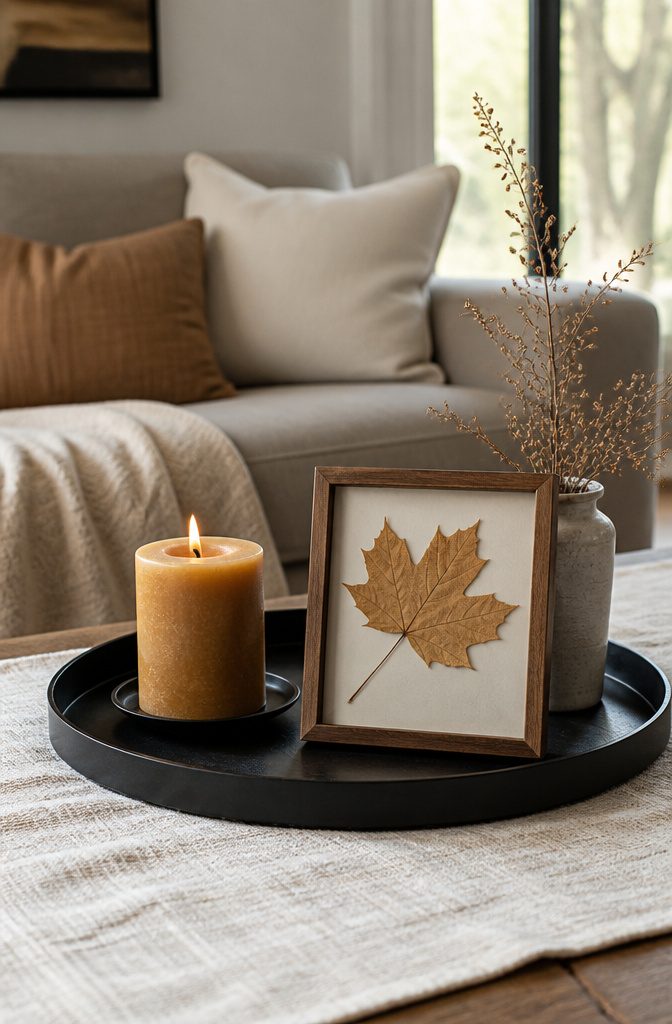
A 5-by-7-inch frame in a thin wood or black metal finish takes up almost no visual space, which is exactly why it works.
I set mine off-center with a single beeswax pillar to the left and one pressed maple leaf tucked under the right corner of the glass.
That is the whole arrangement. The restraint reads as intentional, not unfinished, and the low profile matters more than the image inside.
A frame thicker than three-quarters of an inch starts to feel like a obstacle, and the tray still has to hold a mug or a remote without tipping.
I have tried this with a small charcoal sketch of bare branches and with a color-block print in rust and cream; both looked like fall because the surrounding space let them.
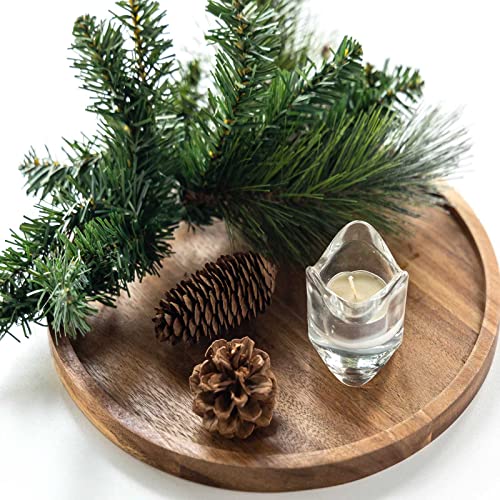
✔️ Natural Wood - Our wooden trays for decor are made of premium Acacia wood. We only use 100% natural wood.

What You Will Receive: the package contains 21 pieces of fall tiered tray decorations, which are enough exquisite autumn decorations; In order to facilitate display, five brackets and enough glue are also provided; You can stick them on the bottom of the decoration to help them stand up, adding they add a touch of rustic autumn style beauty to your home (tray not included)

HIGH QUALITY - Made of the premium paulownia wood, both durable sturdy and super lightweight, about 40% less weight than ordinary wood,hard-wearing and serviceable for a long period to use.The perfect outer 11.2" size(inner diam 9.4")to serve your favorite food and drink for breakfast in bed, parties or for weddings.
4. Rustic Harvest Tray Decor
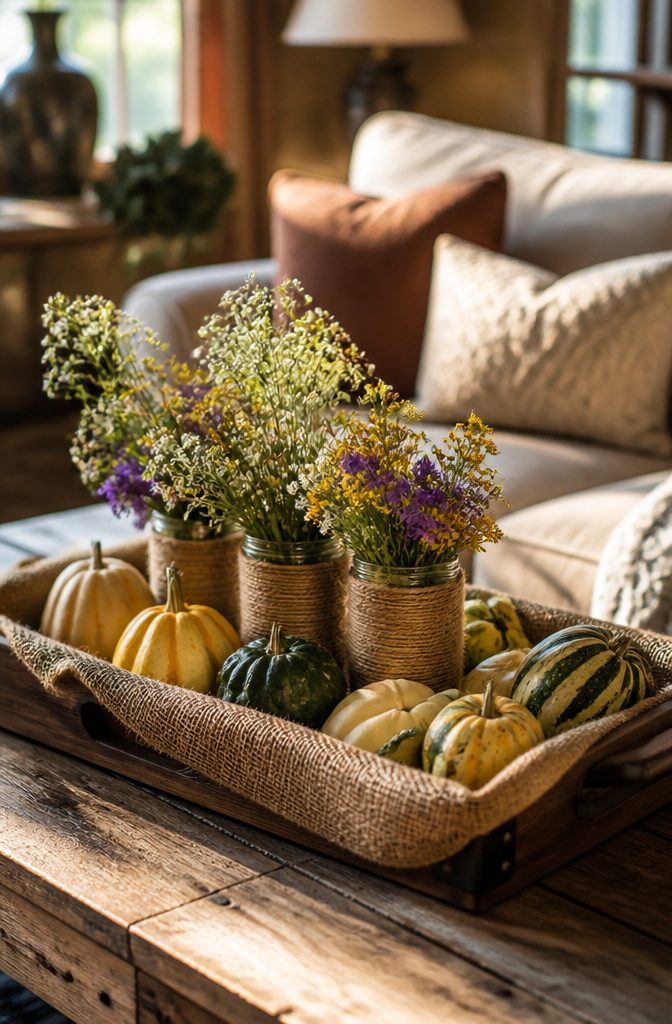
Burlap under a centerpiece adds instant texture, but the loose weave sheds fibers onto whatever sits below it. A tray with a raised lip or a fitted liner catches those strays before they scatter across the coffee table.
Twine-wrapped mason jars look handmade and warm, though the jute can leave oil marks on painted surfaces if the twine sits directly against them. The liner matters more than the tray material here.
Miniature gourds in their natural, unwaxed state bring the best color variation, ranging from pale green to deep orange without any factory shine.
That raw finish comes with a catch: the skin softens as it dries and can weep onto the tray below.
I learned this the hard way after a small gourd left a faint stain on a whitewashed wood surface that never quite sanded out.
A lip keeps rolling gourds contained too, which matters more than you’d think once kids or pets move through the room.
These three elements together, burlap, twine, and raw gourds, read as collected rather than bought as a set. The shed and stain risk is real, but it is manageable with the right tray.

🍁🌾【Natural Looking】- Artificial fall flower plants are pretty, maple leaves are realistic and the texture is clear, just like real plants but it never wither.

Reliable Material: the tree branches are made of plastic and silk, not easy to fade or break, vivid and realistic, can decorate balconies, decks, doors, stair railings, gardens, fences, tables, fireplaces and more

🌾 Wonderful combination: There are a total of 3 pcs artificial autumn flowers, each with a total length of 19.68 inches, which incorporates the most autumnal natural elements into the bouquet, such as corn ears, autumn yellow leaves, etc., bringing a sense of harvest .
5. Glam Fall Tray with Golden Eucalyptus
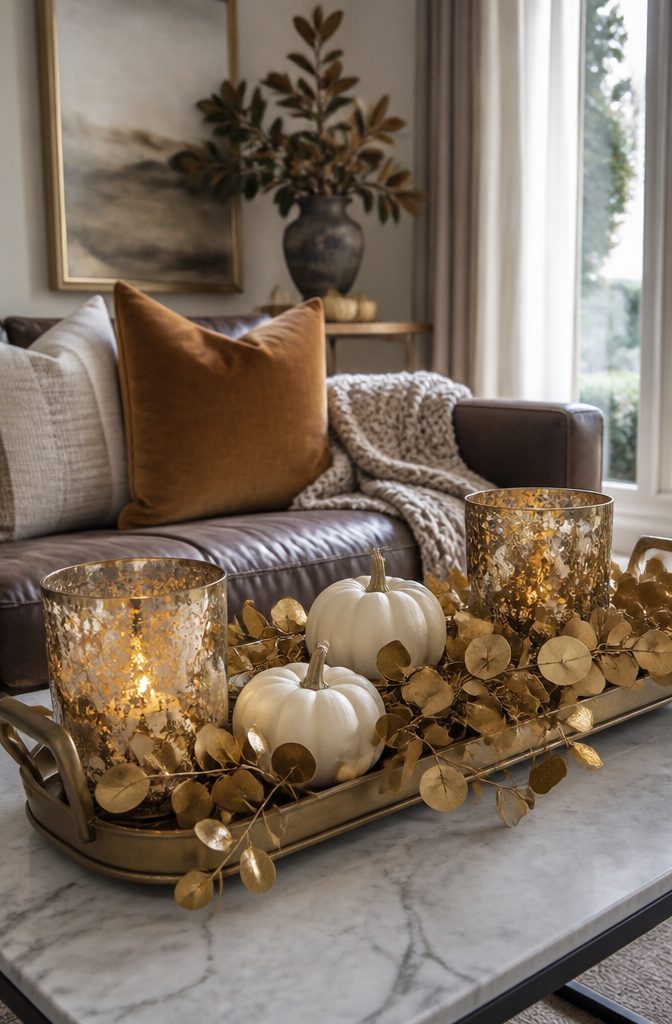
Golden eucalyptus reads as fall without a single orange leaf. The branches carry that warm metallic tint through sprayed or dried finishes, and they hold up two to three weeks before crumbling, long enough to outlast most fresh arrangements.
Pair them with mercury glass votives so the gold has something to flicker against, and tuck in small white pumpkins to keep the palette from going flat.
The votives do the heavy lifting at night. Their mottled silver-gold surface catches candlelight the way polished metal would, but softer.
Three or four stems laid low across a tray, a votive at each end, and the pumpkins in between gives you enough height variation without anything towering over the coffee table conversation.
White pumpkins matter here. Orange would slide the whole thing toward harvest-fair territory, and the point of this setup is restraint.
If you want more warmth, bronze acorns or a gilded mini pumpkin at the back edge work, though I would stop there. The eucalyptus already carries the metallic theme; more gold risks reading as holiday rather than fall.

VINTAGE FALL FARMHOUSE WALL ART, 9-PIECE GALLERY SET — A mixed-size collection of fall paintings wall decor (4 prints at 8x10, 5 prints at 5x7) in a warm, painterly vintage style — arrange as one cohesive farmhouse fall decor gallery wall without buying pieces separately.

Fits 5 x 7 Inch Photos: Designed to display one 5 x 7 inch photograph within an 8 x 10 inch frame. The balanced proportions help highlight portraits, family pictures, artwork, postcards, inspirational prints, or special keepsakes.

Vintage Wall Art Decor Poster: Elevate your space with this vintage wall decor set, perfect for adding a timeless charm and warm atmosphere to any room.
6. White and Gold Fall Tray with Cotton Stems
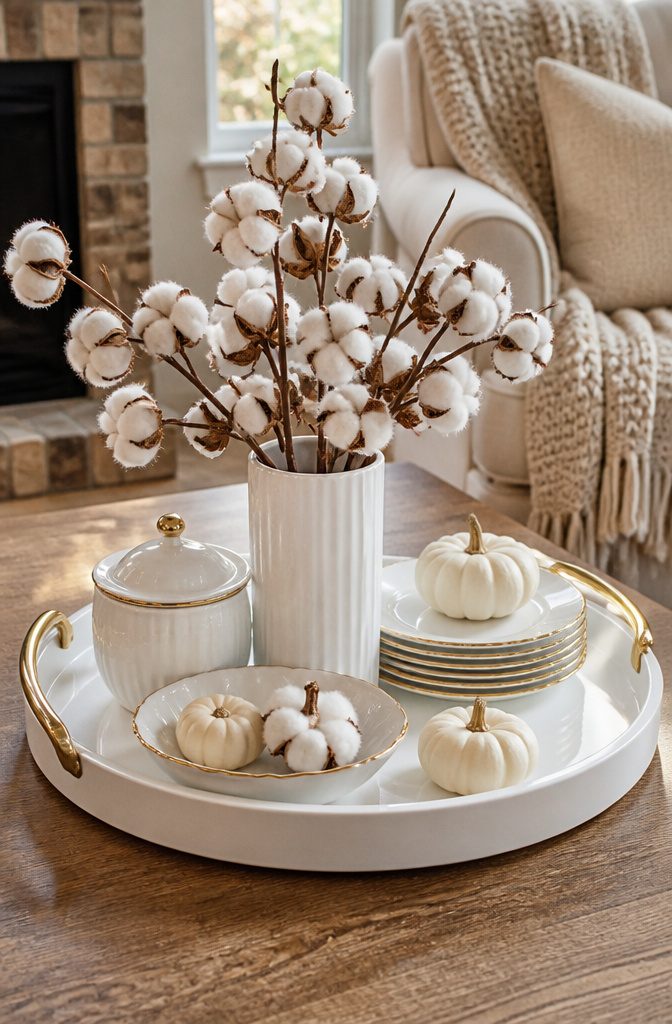
Bleached cotton stems read as neutral rather than overtly rustic, which makes them easier to pair with gold-rimmed dishes without the tray feeling like two themes colliding.
Small white pumpkins bridge the warm metal and the pale stems; the palette stays quiet enough for late November but still reads autumnal once October decorations come down.
The fuzz on cotton stems sheds everywhere if you skip one step. A light mist of hairspray, nothing heavy, sets the loose fibers so they stay put while you arrange and after.
Hold the can at arm’s length and let it fall like a dusting rather than spraying close, or the stems clump and look wet.
Gold-rimmed dishes do not need to match.
A salad plate from one set and a saucer from another, both with thin gold bands, read as collected rather than random. The rim catches light on a coffee table where taller items would block the view across a room.
Keep the stems low and angled, not vertical, so the tray stays flat enough to still hold an actual cup when someone sits down.

FALL DECOR PUMPKIN CANDLES - Crafted from 100% real wax, orange candles feature a 3D wick and built-in light source, making our pumpkin candles more realistic than ever. They add an extra touch of autumn ambiance to your home.

WARM AMBER FLICKERING GLOW: The amber light recreates the rich tone of a traditional flame, while the melted-edge design adds realistic detail up close; bring cozy fall and winter candlelight to pumpkins, mason jars, mantels, altars and rustic displays

Flickering Candles Battery Operated: Each LED candle is powered by 2 AA batteries (Not included) with flickering effect, can light up for 120+ hours continuously
7. Rustic Farmhouse Tray with a Vintage Watering Can
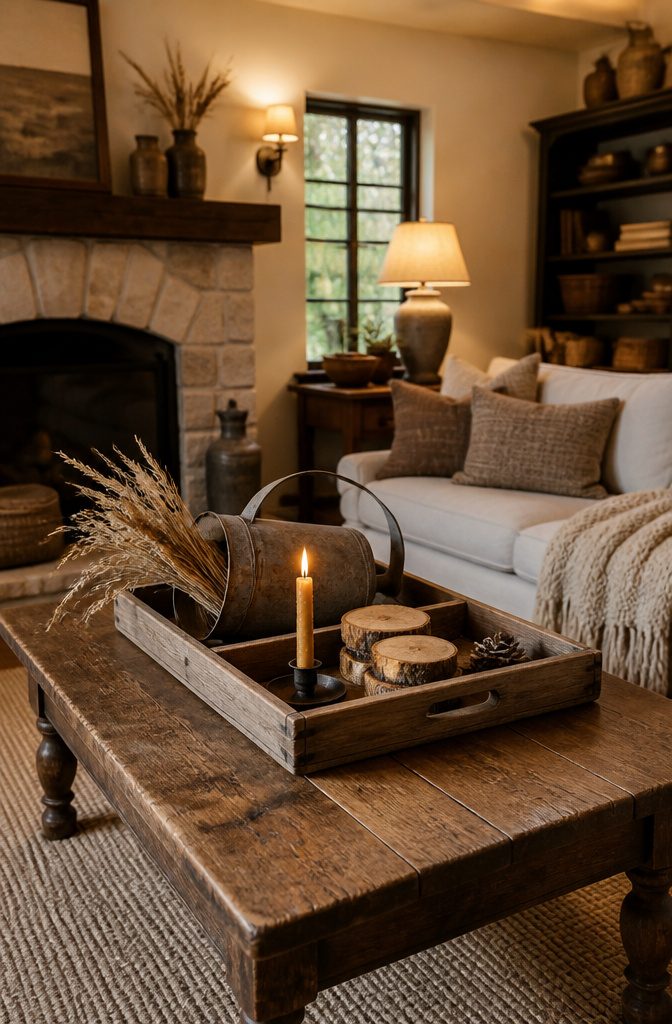
A small vintage watering can with a slow leak makes a better anchor than a perfect one. Water finds the seam eventually, and that rusted patina reads as found rather than bought.
I set mine on its side, opening toward the corner of the tray, and wedge dried wheat or tall oat grass into the spout so the stems fan slightly upward.
The can’s heft keeps the lighter pieces, a stack of split wood coasters or a beeswax taper in a crock holder, from sliding when someone lifts the tray to wipe the table.
Tilt it so the spout clears the tray rim by an inch or two, otherwise the grass tips knock against a candle or lean flat.
If the can still holds water at all, line it with a folded paper towel first; damp metal turns the stems dark at the cut in about three days.
Upright works too, though it reads more garden-shop than farmhouse. The sideways placement lets the handle become part of the silhouette, that curved iron line echoing the round shapes of pumpkins or wooden bowls nearby.

[WHY YOU NEED] - Manspdier food tray is made of elegant Acacia Wood not Cheap Wooden tray and Bamboo tray, or Porcelain tiered serving platter, no additional finish to make cake stand quirky shiny or over rustic chalky feel, our wooden multi layer cupcake holder is no extra finish, just slight smell of nature wod, and keep natural brightness of wooden tone and grain

[WHY YOU NEED] - Manspdier platters for serving food is made of Platane Wood not Acacia Wood platter and bamboo tray, no additional painted to make wood plates quirky shiny and smooth, our wooden plates extra finish, just slight smell of nature wod, and natural brightness of wooden tone and grain.
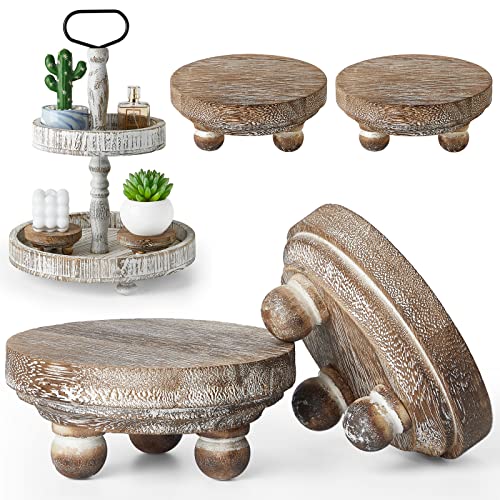
Elegant Foot Design: each mini wood pedestal is designed with three round base feet, adding stability and a rustic atmosphere, and the overall color is very elegant and retro, nice for you to use on the tiered tray
8. Antique-Inspired Fall Tray with a Glass Cloche
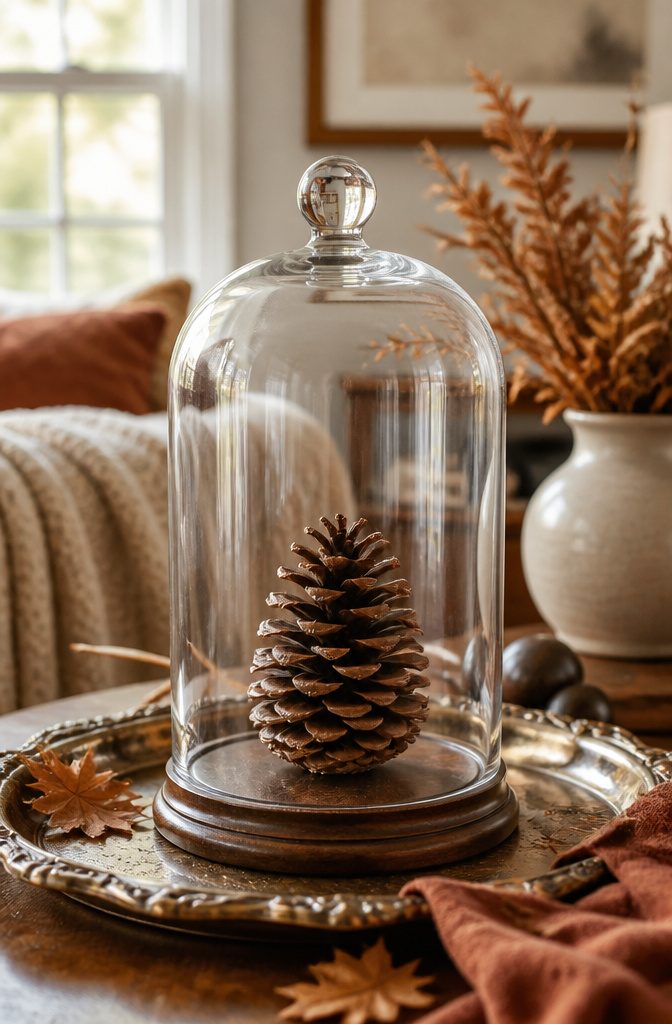
A glass cloche turns whatever sits beneath it into something worth stopping for. The curve of the glass catches light from a window or a nearby lamp, and the lifted base creates a shadow that reads like a pedestal.
A single pinecone, a persimmon with its stem still on, or a beeswax candle inside becomes a specimen instead of clutter.
The catch is practical. The cloche has to come off for use, so this setup works best on a tray meant for looking at, not for holding remotes or coffee cups.
I learned this the hard way with a cloche over a scented candle on my living room tray.
Every time I wanted to light it, I had to find a place to set the glass where it would not roll or scratch the table.
After two evenings of that dance, I moved the whole arrangement to a side table I walk past but do not touch.
For a coffee table that sees daily traffic, skip the cloche or keep it empty.
A display tray on a console or bookshelf, though, gains weight from that one enclosed object. The glass does the curating for you.

SIZED FOR YOUR CENTERPIECE — Each wood slice is carefully selected to meet the listed minimum diameter, giving you the space you need for centerpieces, candles, florals, table décor and more.

Package Includes: this package includes 12 hollow wooden lanterns (self assembly required; Four hollow wooden pieces and two solid wooden pieces can be assembled into one lantern), and 12 electronic candles; Ample stock allows you to decorate as you like

Fall Decorating Set: it's easy to create a warm fall vibe with this 18 piece fall tiered tray decorating set, which includes 18 wooden signs, 2 brackets, dot sticker, and twine; Great for coffee bars, kitchen counters, dining tables, mantelpieces and entrances, these rustic farmhouse decorations will bring a cozy fall vibe to any space
9. Cozy Couch Tray with Muted Pumpkins and Candles
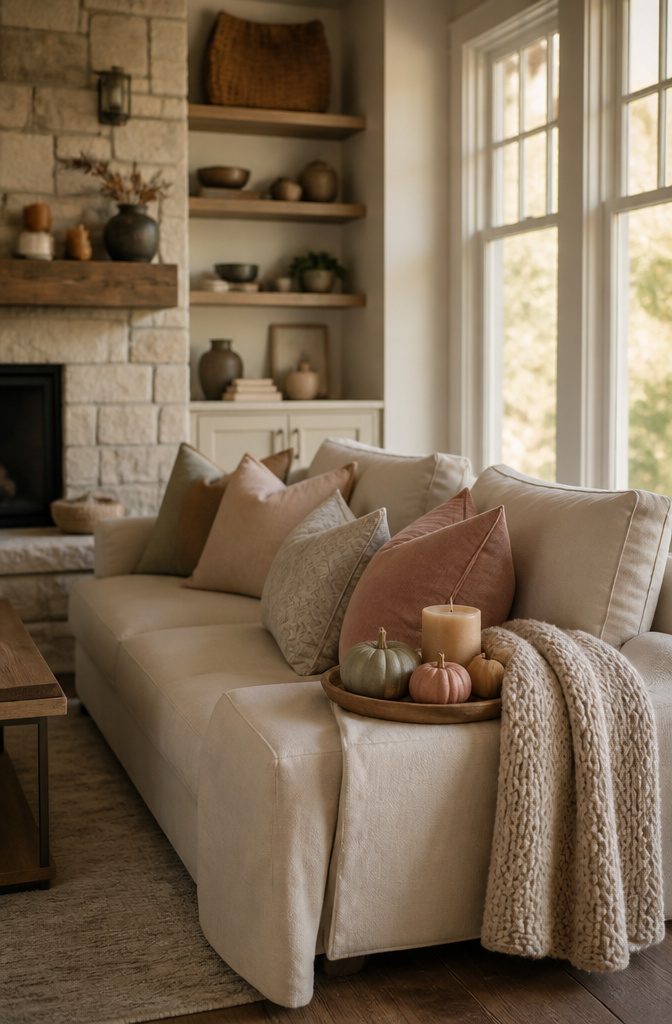
A tray sized for an ottoman or sofa arm reads smaller than a coffee table spread, which is exactly the point. The eye travels less, so every object carries more weight.
I start with matte-finish pumpkins in gray-green or dusty rose, the kind that read as found objects rather than seasonal props. Their finish matters more than their shape; gloss would fight the low light where this tray actually lives.
One beeswax pillar, not a cluster, sits slightly off-center. Its color should sit somewhere between the pumpkins and the wood of the tray itself, so the whole arrangement recedes into the room instead of announcing itself from the doorway.
The palette works because nothing in it competes with the actual textiles of a lived-in couch: the cable-knit pillow, the throw dragged to one corner.
The mistake is adding a third color or a second candle. Two pumpkins and one pillar is the limit for a tray this size.
Anything more and the composition becomes a centerpiece, which defeats the purpose of a piece meant to blend into the peripheral vision of someone reading or half-watching television.

Package Includes: you will receive 8 pieces of artificial leaves for decoration in 4 styles, which are practical and innovative; The length of each artificial maple leaf is about 15.75 inches; Sufficient quantities can meet your daily use and replacement needs, and you can also share them with your family or friends

【Tri-Color Autumn Elegance】Each group contains three independent color scheme simulated maple branches (autumn red/dark red/purple), each with 21 silk leaves with different textures, restoring the true autumn leaf morphology.Easily match pine cones, fallen leaves and other elements to create a rich autumn atmosphere.

Arrive include 2PCS fake fall leaf plant, each length approx 17.7 inches and the branch unfold diameter approx 11.8 inches
10. Fall Floral Pumpkin Arrangement Tray
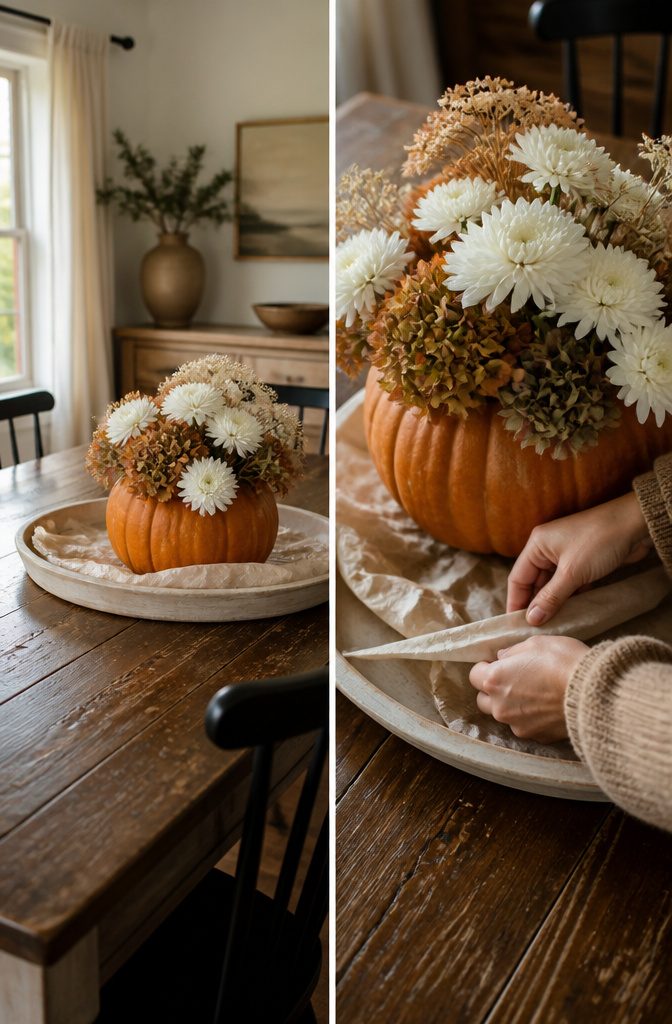
A real pie pumpkin, hollowed with a serrated spoon and fitted with a small glass jar inside, makes a vase that lasts about five to seven days before it starts to soften.
I line the tray underneath with a tea towel or a few layers of parchment first; the pumpkin will leak as it breaks down, and catching that mess early saves the finish underneath.
The five- to seven-day window is firm, so this works best for a dinner party or a short stretch of October when you want something alive on the table without committing to a ceramic pot for the season.
Mums fit the opening neatly, and sedum or dried hydrangea hold up without water if you prefer to skip the jar entirely.
Fresh stems in water keep longest, but even dried material looks richer against the orange rind than it would in a plain bowl.
Once the pumpkin starts to give at the base, it goes straight to compost; the tray lining goes in the wash or the trash, and the surface underneath stays clean.

Framed Vintage Art Prints for Style and Personality: This high quality canvas artworks add classical elegance and sophistication to your home and brings a sense of tranquility! Whether displayed together or individually in different rooms, these artworks transform ordinary walls into galleries of artistic expression

Rustic Charm with Reclaimed Wood - Crafted from 100% reclaimed wood, this frame brings a warm, earthy touch to your space. Each piece has its own story, making it a unique addition to farmhouse, cottage, vintage, or nature-inspired interiors. The naturally weathered wood tones add texture and character to your home

Professional Quality Print on Archival Photo Paper with Luster Finish
11. Cozy Coffee Table Fall Decor with a Knit Throw
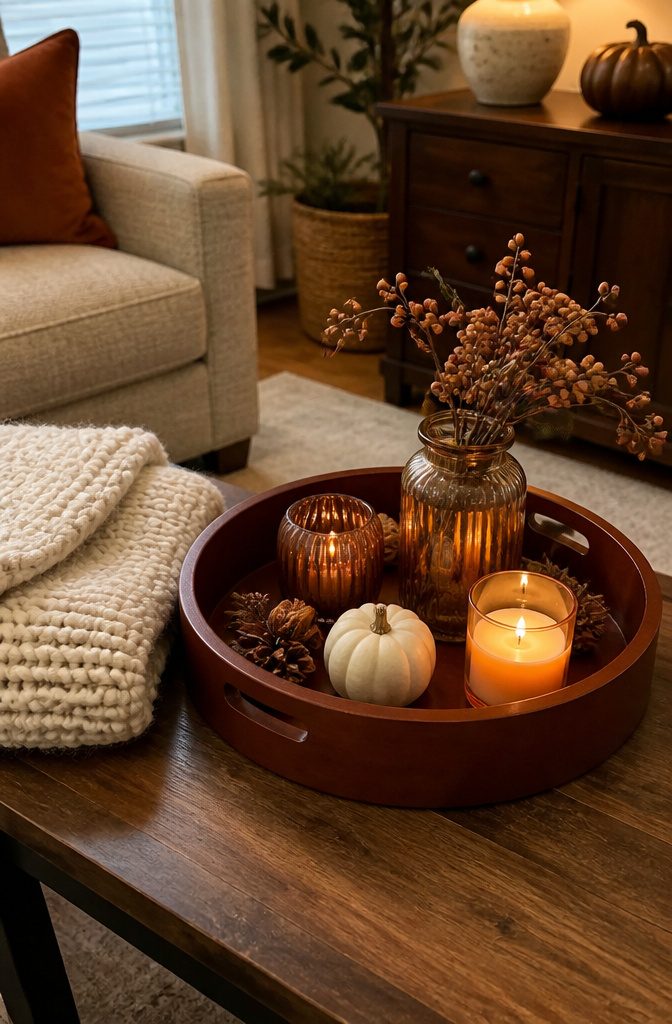
A folded chunky knit throw beside your coffee table tray does more work than one tossed over the back of the couch.
The texture reads as autumn without crowding the tray’s working surface, where you still need room for a coffee mug and the remote.
Match the throw to the tray, not the other way around.
A rust-toned tray pairs with cream or beige knits; a cream tray holds its own against a deeper orange or cinnamon throw. The contrast keeps both pieces from disappearing into each other.
I learned this the hard way last season with a charcoal tray and a gray throw.
The whole corner went flat. Swapping in a warm ivory cable knit against the dark wood made the same objects on the tray look intentional rather than leftover.
The throw stays folded, never draped across the tray itself.
That distinction matters if you actually use the tray daily. A soft stack on the ottoman or a chair arm keeps the cozy signal clear while the tray stays functional for candles and whatever you’re drinking.
Foraged natural finds, orange tones, and creamy beige knits together hit the balance between woodland walk and living room sanctuary. The throw supplies the softness; the tray supplies the structure.
12. Vintage Crock and Berry Branches Fall Tray
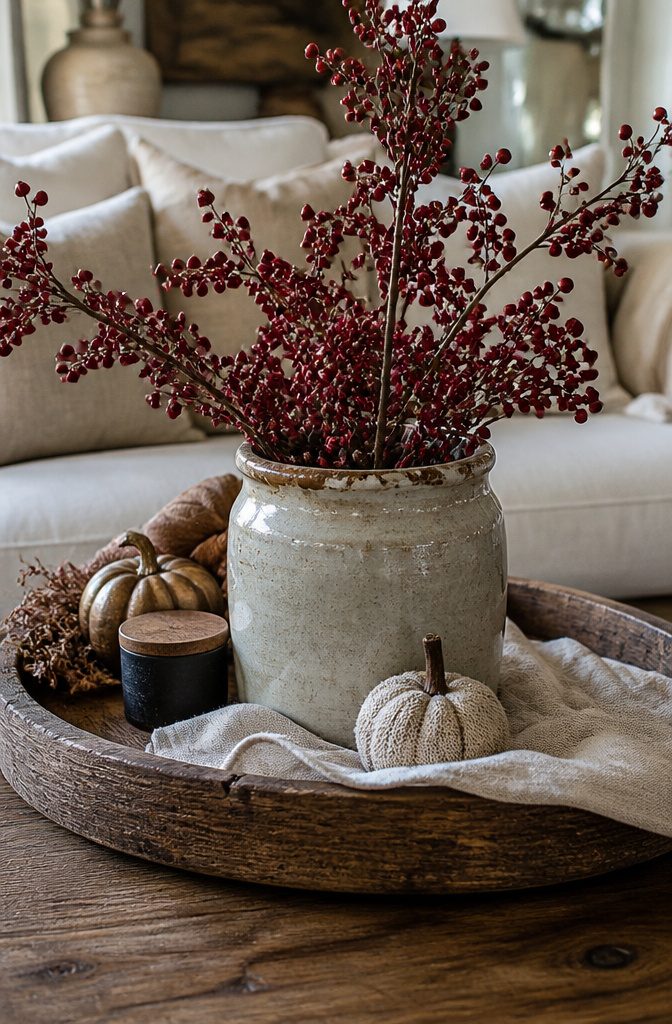
A stoneware crock with a chip-rimmed edge still does the heavy lifting on a fall tray. The weight alone keeps berry branches from tipping, which matters more than you’d think once you start layering in other pieces.
I reach for artificial or dried berry branches in deep red or burgundy.
The crock’s neutral glaze, usually a soft gray or warm oatmeal tone, stays quiet enough that those berries become the only real color statement. That restraint reads as intentional rather than sparse.
The chip itself becomes texture, not a flaw. Turn it toward the back if it bothers you, but I usually face it forward where the light catches the worn rim.
Against smooth manufactured surfaces elsewhere in the room, that uneven edge signals something found rather than bought last Tuesday.
Fill the crock loosely.
Branches packed too tight look like a supermarket bouquet, and the whole point here is the loose, gathered-from-the-hedgerow shape that stoneware has carried for two centuries. Three or five stems, uneven numbers, leaning at slightly different angles.
This arrangement lasts the full season without water, without dropping leaves, without the berry branches fading to that dusty brown that real holly and winterberry hit by mid-November.
13. Fall Tiered Tray Decor with Vintage Items
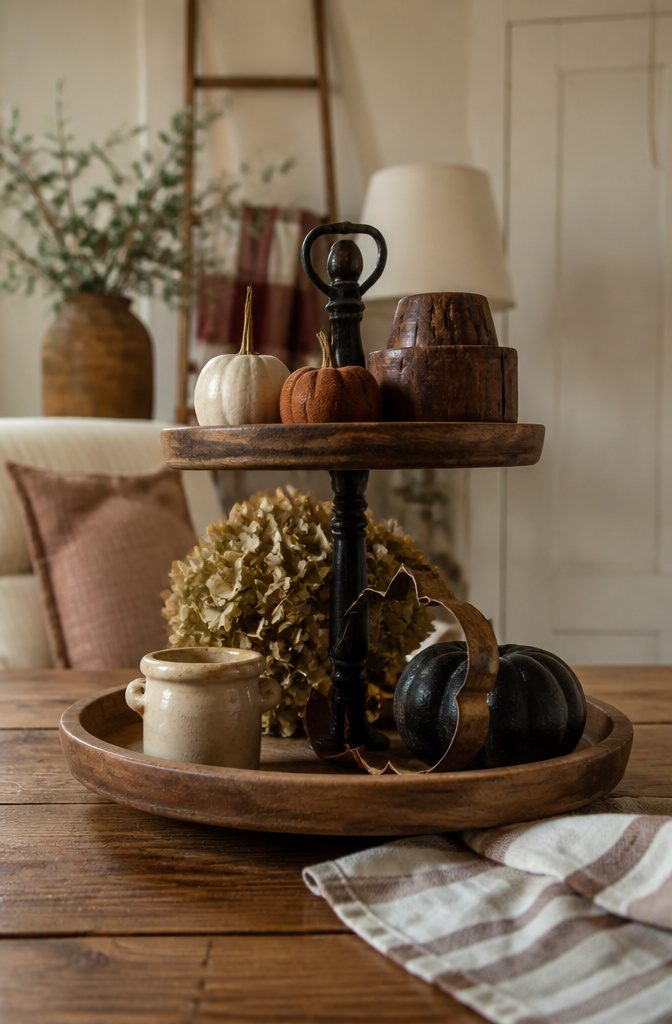
Tiered trays force a decision most flat surfaces do not.
Each shelf has less headroom than the one below it, and a full pumpkin that reads charming on a coffee table reads like a traffic jam when it blocks the view of everything underneath.
The small vintage items solve this.
A thimble-sized salt crock, a wooden butter mold, a rusted cookie cutter scaled to the tier, these carry the weight of curation without the bulk that crowds a narrow ledge. The eye moves up the levels because nothing stops it.
Scale is what separates collected from cluttered.
A miniature rolling pin belongs on the top tier. A standard one belongs in a drawer.
What worked for me was treating each level as its own still life rather than stacking fragments of one scene.
The salt crock with a sprig of dried amaranth on the middle tier, the butter mold alone on the bottom, a single cookie cutter propped like a sculpture above.
The rust and wood patina do the autumn work without any orange required.
14. Buffalo Check Pumpkins Tiered Tray Decor
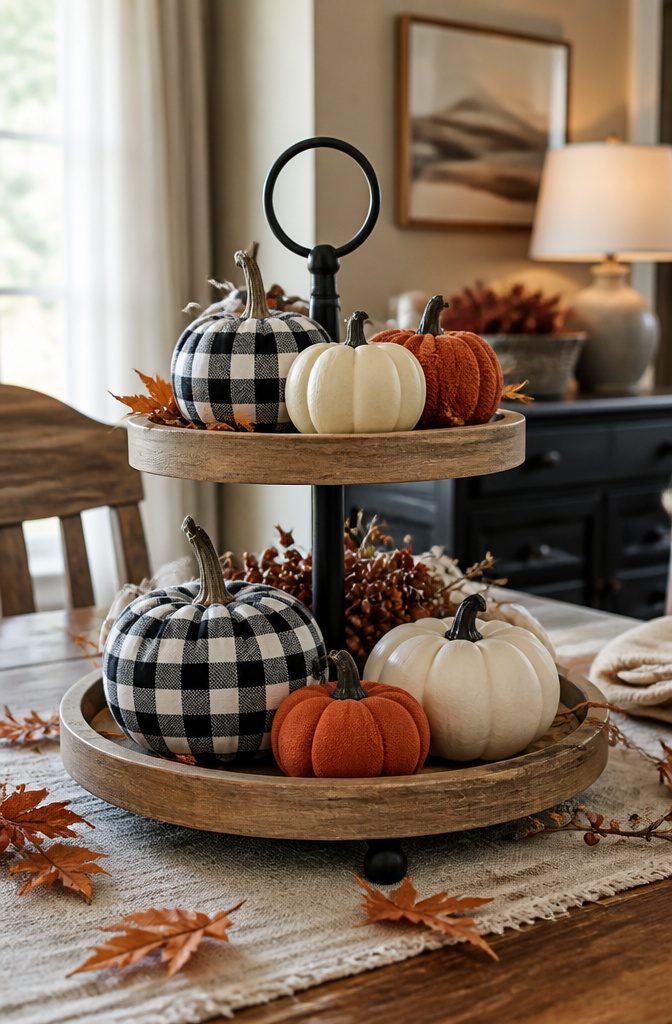
Buffalo check pumpkins pull a tiered tray together faster than almost anything else in fall tray decor.
The trick is repeating the pattern at least twice, on two different levels, so the eye catches it, loses it, then finds it again.
That second sighting is what tells the brain this was intentional, not a pile of random objects.
I usually wrap small foam pumpkins in buffalo check fabric with a dab of hot glue at the seam, or decoupage paper napkins in the same print if the weave feels too heavy for the scale.
A two-inch pumpkin on the top tier and a four-inch version on the middle tier does the job without matching too perfectly. The scale difference keeps it from looking like you bought a set.
The pattern needs to read from a normal viewing distance, so go for checks at least half an inch wide.
Anything smaller turns to gray mush. Pair them with solid colors, cream or rust, and let the black-and-white do the structural work of tying the levels together.
15. Early Fall Apple Tiered Tray Decor
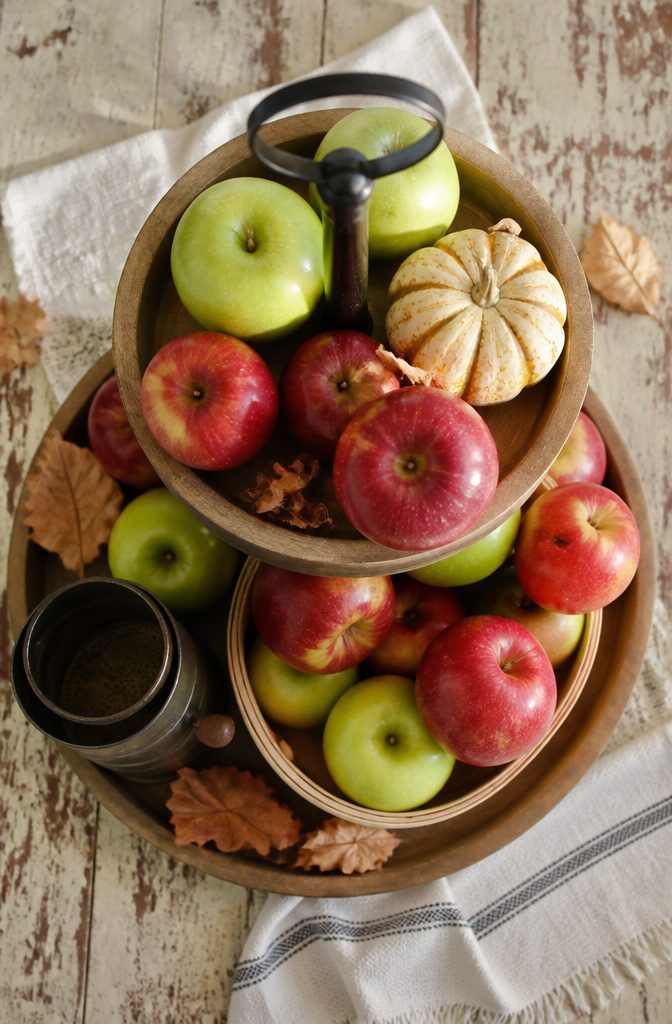
A mix of green and red apples, real or faux, reads as harvest without rushing toward Halloween. August and September sit in that awkward gap where summer produce still fills the bins but the mood has shifted.
Apples bridge it cleanly. On a tiered tray, green Granny Smiths against deep red Fujis or Galas give you color contrast without the orange overload that pumpkin everything brings by October.
The sources lean toward clustering them in something rustic: a small bushel basket or a miniature wagon on the bottom tier if you have the height.
What elevates the look from fruit bowl to decor is pairing the apples with one harvest element that signals intention.
A tiny crock of cinnamon sticks works, or an old sifter, or even a stack of vintage flashcards with apple prints faced outward.
The trick is keeping it to one or two supporting pieces so the tray does not read as clutter.
Faux apples have improved enough that you will not spot them across a room, and they let you set the display in late August without watching fruit soften.
Real apples cost less and smell like something. Either way, swap in a single mini pumpkin come mid-October and the whole tray shifts seasons without a rebuild.
16. Rustic Farmhouse Fall Tiered Tray
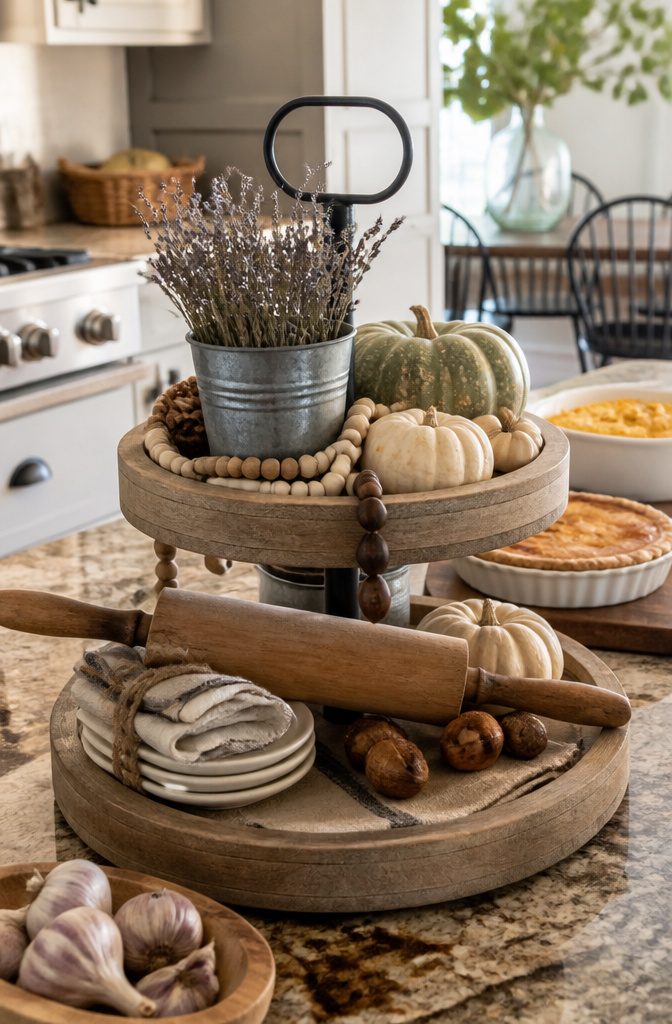
Wood beads read as farmhouse only when they do not match too well. The strand on my own tiered tray came from a garage sale jewelry lot, sanded smooth and strung on twine that had already darkened with age.
That variation in tone, some beads nearly walnut and others still pale pine, keeps the eye moving past what would otherwise look like a craft-store rope.
Galvanized metal works the same way.
A single miniature bucket or a lid from an old canning jar cools down all that warmth. Without it, the tray collapses into a brown lump.
The tiny rolling pin seals the reference without shouting it; mine is nine inches, carved from beech, and sits at an angle that suggests someone left it there mid-task rather than placed it for a photograph.
Dried lavender splits the difference between rustic and refined.
A single sprig, stem bent to follow the tray curve, gives a gray-green note that neither pumpkin nor wood provides. The metal piece should sit lowest, where the eye settles last; beads and lavender draw attention upward.
17. DIY Tiered Tray Decor for Fall
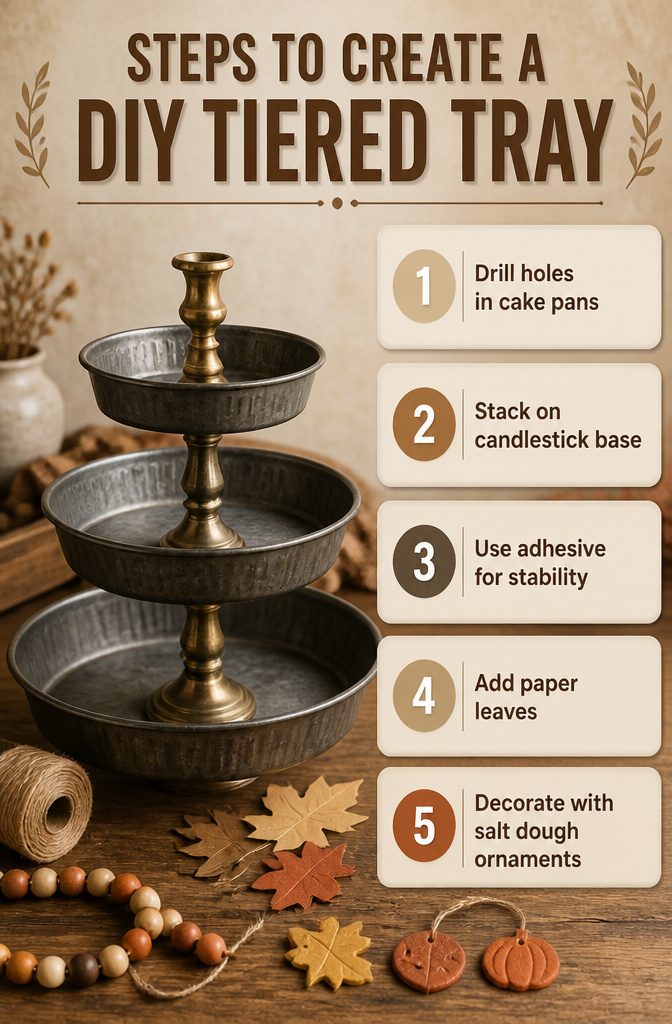
A tiered tray built from stacked cake pans or pie tins and candlesticks costs almost nothing and takes under an hour, which is why the slightly wobbly, definitely homemade finish feels like a feature rather than a flaw.
I start with three graduated pans, drill a hole through each center, and thread them onto a central candlestick with a second candlestick as the base.
A few dabs of strong adhesive between the joints, and the structure holds well enough for lightweight decor.
Paper leaves work better than real ones here because they keep their color and lie flat against the metal. I punch them from kraft cardstock and curl the edges slightly so they catch light between the tiers.
Salt dough ornaments painted in matte ochre and rust fill the middle level without adding much weight. Wooden beads strung on twine and brushed with watered-down acrylic make a simple garland that drapes between the levels.
The trick is letting the paint stay a little streaky, which reads as intentional texture on a handmade piece rather than a mistake. Nothing on this tray needs to match, and that is exactly the point.
18. How to Style a Fall Tiered Tray
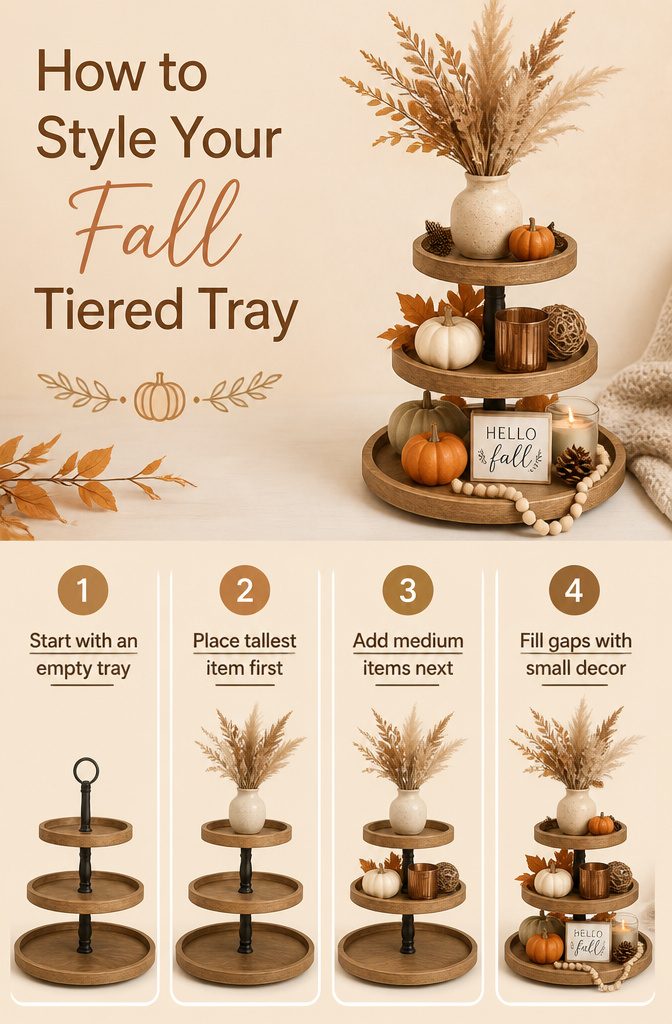
- Start with the tray completely empty, even if you already have a rough idea of what goes where. Seeing the bare tiers in front of you keeps the arrangement from looking like you simply piled on whatever was within reach.
- Place the tallest piece on the top tier, but only if the headroom there actually accommodates it. A vase with dried greenery or pampas grass works well when the shelf above gives it clearance; forcing height where the space is cramped throws the whole thing off.
- Move downward with progressively shorter items. The middle tier holds your medium pieces, and the bottom tier gets the lowest. Step back after each tier to check balance before you continue. The tray reads as a single composition, not three separate piles, and distance reveals what standing over it hides.
- Fill gaps last with the smallest things: beads, pine cones, a single small gourd tucked beside a candle. These are not afterthoughts, but they are easier to place once the structure is set. Too many early, and they compete for attention; too few, and the tray looks unfinished.
DIY Ideas for Personalizing Fall Trays
The projects that actually fit into a weeknight evening are the ones most of us finish, so I sorted these by real time, not craft-store optimism.
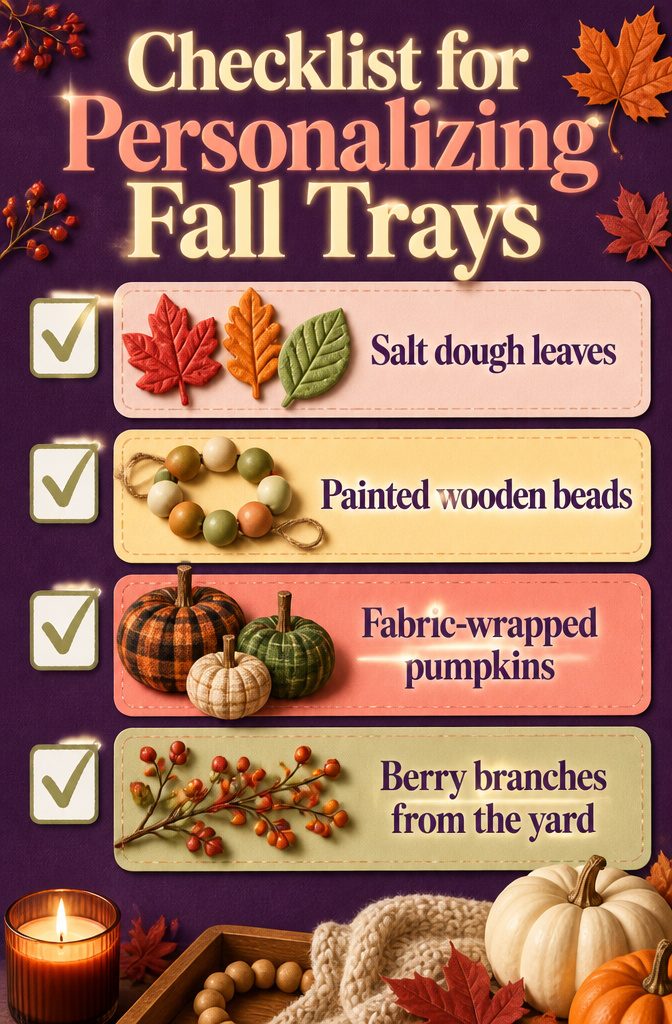
- Salt dough leaves need an overnight dry, but the active work is under twenty minutes. Roll the dough thin, press in real leaves for the vein pattern, and cut around them with a butter knife. Paint them the next evening while something else bakes.
- Painted wooden beads string onto twine for a garland in about fifteen minutes, plus drying time. I use three colors max; more than that and they start reading as a kid’s craft project.
- Fabric-wrapped pumpkins take closer to forty minutes once you factor in tucking and hot-gluing, but they need no drying. Old flannel shirts work better than quilting cotton; the weight sits right on a tray.
- Berry branches from the yard are the fastest fallback. Cut them to tray height, strip the leaves off the bottom two inches so they lie flat, and replace them when they dry out in about ten days.
Color Schemes That Read as Fall
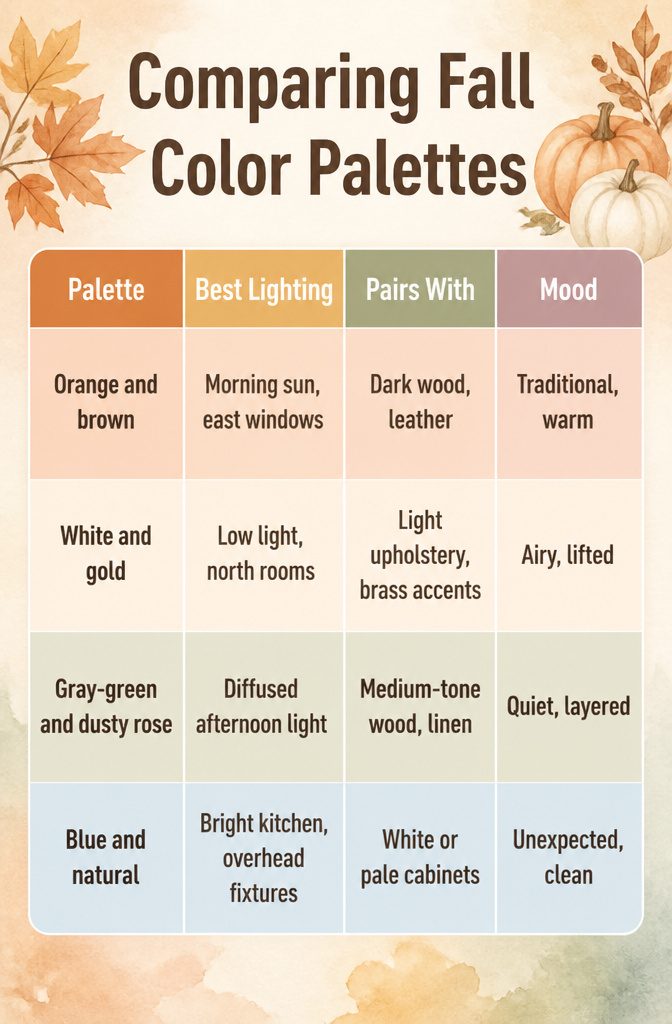
The same four palettes kept showing up as I sorted through what actually works on a tray. Orange and brown reads warmest in rooms with morning light, where the amber tones pick up a golden cast.
White and gold does the opposite; it brightens a dim corner without the weight of traditional fall colors, and the brass keeps it from feeling like winter came early.
Gray-green with dusty rose sits well against medium-tone wood furniture, the kind of muted pairing that doesn’t fight a sofa you already own.
Blue was the outlier I didn’t expect to see, used with painted pumpkins and natural raffia for a kitchen tray that skips orange entirely.
| Palette | Best Lighting | Pairs With | Mood |
|---|---|---|---|
| Orange and brown | Morning sun, east windows | Dark wood, leather | Traditional, warm |
| White and gold | Low light, north rooms | Light upholstery, brass accents | Airy, lifted |
| Gray-green and dusty rose | Diffused afternoon light | Medium-tone wood, linen | Quiet, layered |
| Blue and natural | Bright kitchen, overhead fixtures | White or pale cabinets | Unexpected, clean |
Pastel made only one appearance, buried in a blue-and-white chinoiserie pumpkin that read more as accent than scheme. I’d treat it as a single touch within white and gold rather than a palette on its own.
Frequently Asked Questions
How do you decorate a fall tiered tray?
Start with the tray completely empty so you can see the bare tiers clearly. Place the tallest piece on the top tier only if the headroom allows it, then work downward with progressively shorter items on each level.
Step back after each tier to check balance from a distance before filling any remaining gaps with the smallest accents like beads, pine cones, or a single small gourd.
What are some ideas for fall tray decor?
The article covers eighteen distinct approaches, ranging from an autumn lantern with battery-operated candles and burgundy maple leaves to a glam setup with golden eucalyptus and mercury glass votives.
Other options include natural accents stacked on neutral hardcover books, a minimalist framed print with a single beeswax pillar, a rustic harvest arrangement with burlap and twine-wrapped mason jars, and a cozy ottoman tray with matte-finish pumpkins in muted tones.
For tiered trays specifically, vintage miniatures, buffalo check fabric pumpkins, early fall apples, and DIY projects using stacked cake pans all work well.
How can I make my fall tray decor look chic?
Stick to a curated color palette and let restraint do the work.
The white-and-gold tray with cotton stems and mismatched gold-rimmed dishes stays quiet enough for late November but still reads autumnal, while the minimalist frame setup uses just three objects off-center to feel intentional rather than unfinished.
Avoid orange overload; golden eucalyptus with white pumpkins, or sand-toned matte textures against warm wood, keep the look elevated without bright colors.